| |
OW
IT MAY BE ENLIGHTENING IN OUR EXPLORATION of the wonderful
being, Lord Ganesha, to share with you answers to some of
the questions most commonly asked about Him by the many
inquirers worldwide. Hopefully these insights will inspire
you to draw closer to Him and learn about His grace and
His ever giving boons through your own experiences. Yes,
Lord Ganapati is a mysterious God to most adults, but not
to children. We too must be like little children to really
enjoy and understand His majesty, mirth, wisdom and simple
complexities. The God whose symbol is the swastika, who
moves in many directions all at once, is truly, to a child,
as simple as a digital on-and-off switch. Children who grow
up in the ten arms of Him who has no second are quick and
resilient mind, amenable to change, not affected by wealth
or poverty, adjustable and secure in His daily darsana before
they worship other Lords of their choice.
Devotee: What is
the nature of Lord Ganesha?
Gurudeva: Lord Ganesha is a Mahadeva, a Great
God, created by Lord Siva to assist souls in their evolution.
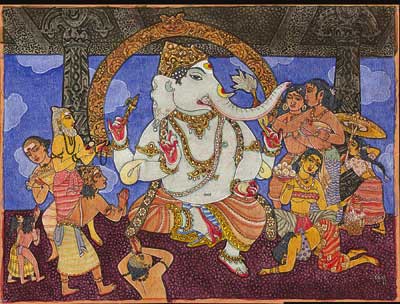
He is the elephant-faced Patron of Art and Science, the
Lord of Obstacles and Guardian of Dharma, the first son
of Siva. His will prevails as the force of righteousness,
the embodiment of Siva's karmic law in all three worlds.
My satguru, Sage Yogaswami,
proclaimed: "The God with the elephant's face I shall never
forget -- Shankara's Son, with massive belly and the ring
in His ear, the Lord who gave His grace to Indra, of whom
mantra is His very form." I often explain Lord Ganesha in
this way: "Lord Siva, the Almighty Power, created heaven
and earth and the God, Lord Ganesha, to oversee the intricate
karmas and dharmas within the heavens and all the earths.
Lord Ganesha was created as a governor and interplanetary,
intergalactic Lord. His knowledge is infinite; His judgment
is just. It is none other than Lord Ganesha and His mighty
band of ganas that gently help souls out of the Naraka
abyss and adjust them into higher consciousness after due
penance has been paid, guiding them on the right path toward
dharmic destiny. He is intricate of mind, loving pomp, delighting
in all things sweet and enjoying adulation. Lord Siva decreed
that this son be worshiped first, even before Himself. Verily,
He is the Lord of Karma. All Mahadevas, minor Gods, devas
and sentient beings must worship Lord Ganesha before any
responsible act could hope to be successful. Those who do
not are subject to their own barriers. Yea, worship of Him
sets the pattern of one's destiny. Thus, this mighty ruler
is truly a great God. The 2,200-year old South Indian scripture
Tirumantiram says, "Five-armed is He, elephant-faced,
with tusks protruding, crescent-shaped, son of Siva, wisdom's
flower; in heart enshrined, His feet I praise."
Devotee: What
is Lord Ganesha's special role?
Gurudeva: He
is Vighneshvara, Lord of Obstacles. As such, He controls
our evolution by preventing or permitting events to happen
in our life.
Lord Ganesha holds the architect's
plans of the divine masterpiece of universal past and future
of this small world and all the galaxies. They were entrusted
to Him when He took office by command of God Siva. His rule
is compassionate, His disciplines strong. He is equally
feared and loved. His law is just, for justice is His mind.
He enjoys adulation, festivity, hearing of His name, for
this brings the devotee into His court, into His presence,
close to Him. Only good comes from Lord Ganesha, who by
taking the form of an elephant distinguishes Himself from
other Gods. He staves off misfortune for those who perform
penance in His name. He is within us and not otherwise,
closer than our heartbeat, guiding our karma through the
timing of events. Our Lord of Obstacles prevents us from
hurting ourselves through living under an incomplete concept
or making a request unneeded or beginning an endeavor not
well thought out. He expects us to use all of our intellectual
and intuitive faculties and resources, to employ the knowledge
available to us before submitting petitions to Him. It is
for us to try to arrive at the right decision, the one that
He Himself would have made in granting the acquisition.
Thus, this Mahadeva, wise and all-powerful, truly is a great
God. The ancient Agamas declare, "These Lords who,
it is said, on the pure path, attend to the various duties
deriving from a higher realm of maya are at the prow of
the effects of the higher realm of maya."
Devotee: Why
must we supplicate Lord Ganesha before beginning any worship
or task?
Gurudeva: At
the command of God Siva Himself, we supplicate, that is,
humbly request, Lord Ganesha to clear obstacles from the
path of our endeavor, if it be His will. As Lord of Obstacles,
Ganesha wields the noose and the goad, icons of His benevolent
power of preventing or permitting events to happen in our
life. Thus, we invoke His grace and wisdom before any worship
or task.
My satguru, Sage Yogaswami,
proclaimed: "May the Supreme Guru, who bestows on me His
grace, be my protection! May the elephant-faced God be my
protection! May the fair child who wields the shapely lance
be my protection!" I have answered this question in this
way: "The father and mother, in a properly conducted home,
govern their children and prepare them to be fine citizens.
The children ask permission from their parents before beginning
any new endeavor. The employee asks permission from the
employer before beginning any new endeavor. The subjects
in a realm ask permission from the monarch before beginning
any new endeavor. Why wonder we about asking permission
from His Majesty, Lord Ganesha, governor of this world,
head, chieftain of our religion, before beginning any new
endeavor? He of intricate mind and power is immediate and
aware of any form of sincere prayer and supplication, humble
requests to clear obstacles from the path of our endeavors,
but only if that be His will. Thus, this loving God rules
our lives, commanding acknowledgment and adulation -- a
truly great God is He.
Devotee: What does
it mean when an obstacle is encountered despite our sincere
supplication of Lord Ganesha?
Gurudeva: It
may mean that the time, the means or the goal itself is
not right for our karma and dharma. The architect
presents his finished plans to the engineer. They are rejected
for one technical reason or another. The executive presents
a completed letter to the president. It is rejected as not
being explicit enough in the third paragraph. The architect
and the executive were equally sincere in presenting their
work. The engineer and the president were performing their
duty as well. Lord Ganesha loves us. He is a loving God
who guides, governs and controls with speed and accuracy
when the plan is perfect, deliberates long and rejects often
when the plan needs revision. Take the plan back into your
mind. Search your own superconsciousness for the greater
ideas, and revise your efforts with confidence. Seek for
the right timing, and proceed with confidence when you know
the timing to be right. "When the will rises and commands,
even the Gods are willing to obey," or to give immediate
cooperation, to guide and enhance our efforts. We must work
our minds in close cooperation with the mind of Lord Ganesha,
and then success is certain. Thus, this God is called Bhaktavighnavinasana,
He who destroys the obstacles of the devotees.
If you worship the elephant-faced Vinayaka,
your life will expand bountifully.
If you worship the white-tusked Vinayaka,
your desires and doubts will flee.
Therefore, worship Him
with love-offerings of jack, hoppers,
plantain and mango fruits
and thus mitigate the burden of deeds.
Saint Auvaiyar
O, Elephant-Faced One!
You are so near and we are far from You.
You are in and we are out;
You are at home, while I'm a stranger.
Yet, You have destroyed my egoity.
I shall sing Your praise forever
and lay my garland of songs at Your feet.
Saint Nambiandiyadigal
He is worshiped with red flowers.
Unfailing, merciful, the origin of the worlds,
He appears at the beginning of creation,
alone, beyond Nature, beyond the Cosmic Person.
He who meditates on His form
becomes great among the yogis.
Ganapati Upanishad
Gaja, the elephant, is the origin
and the goal.
The stage reached by the yogi in his
experience of samadhi is called ga, the "goal,"
and the principle called ja, the "origin,"
is that from which the syllable
of obeisance, Aum,
is said to be issued.
|