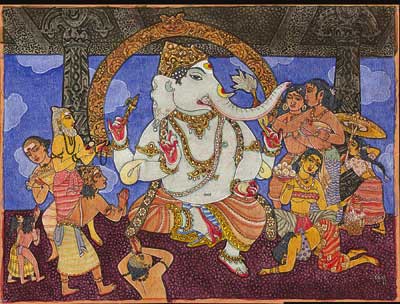
Offer rice three times.
dhyayami
avahayami
ratnasinhasanam samarpayami
We now meditate on Lord Ganesha. In all
splendor we have prepared for You a jewel-studded, lion-footed
throne to sit upon, Lord Ganesha.
Offer a pinch of rice to the
Deity as you chant each line of the above meditation and
invocation. Visualize God Ganesha seated on a golden throne
before you, smiling, full of blessings, waiting to be honored
as a guest in the home of His devotee.
Arghyam
Bathing the feet and hands of God Ganesha
Offer water two times into the tirtha
cup.
padayoh padyam
padyam samarpayami
hastayoh arghyam
arghyam samarpayami
We now humbly bathe each of Your white lotus
feet and gently wash each of Your precious hands, Lord Ganesha.
With your right hand offer
a spoonful of pure water by holding it up before the Deity
momentarily and then placing it in the tirtha cup.
This is how all water offering is done throughout the puja.
As you chant the first line, visualize yourself bathing
the feet of Ganesha. Offer a second spoonful of pure water
as you intone the next line and visualize yourself washing
His hands.
Achamanam
Offer water.
Aum bhur-bhuvah suvah
achamaniyam samarpayami
Aum! In the presence of all three worlds,
O Lord Ganesha, we humbly offer You fresh, pure water for
sipping.
Offer a spoonful of pure water
to Ganesha. This time visualize Him accepting it in His
Hand and sipping it.
Abhishekam
Bathing the Lord with pure water
Ringing bell, hold flower and sprinkle
murti.
Aum surasindhu samanitam
suvarnakalashasthitam |
snanartham grihyatam shambho
Set bell down.
salilam vimalam Ganesha ||
We now bathe You, beloved Lord, the pure
one, with the water present in the golden pot brought from
Ganga through akasha, space.
While ringing the bell and
reciting this auspicious, purifying hymn, dip a flower into
the tirtha water and gently sprinkle the Deity. Do
this three times or more. Hold the flower in your right
hand in the mrigi mudra, the stem between your third
and fourth fingers. If the altar design allows, you may
pour water over the murti rather than sprinkling
it during this chant.
Alankaram
Adornment and prayer for prosperity
Adorn the Deity with flowers, garlands,
clothing and jewels.
Aum gandham grihana surabhi
mandhakasurasudana,
kunkumadi samayuktam
kulachalaniketana
(repeat while decorating)
Apply vibhuti, sandalwood paste
and kunkuma.
divya parimala vibhuti
chandana kunkumam samarpayami
Aum. O thou Lord Ganesha, son of Lord Siva
who defeated the demon Andhakasura. Hail to Him who resides
at the Himalayas. Now we anoint You with divine and supremely
pure white vibhuti, exceedingly fragrant sandalwood
paste and red, red kunkuma.
During this chant, decorate
the murti or picture and adorn it with the traditional
puja sacraments. The first four lines of the verse may be
repeated again and again until the adornment is completed.
The last two lines are recited once while applying vibhuti
(holy ash), chandana (sandalpaste) and kunkuma
(red powder).
Mangalakshatan
Offering rice and flowers
Offer rice, then flower(s) or more rice.
tadupari mangalakshatam samarpayami
pujarthe nanavidhapatra
pushpani samarpayami
We now offer this auspicious unbroken rice.
And for the fulfillment of our devotion, we offer fresh,
blooming flowers for Your enjoyment, our peerless Lord.
A pinch of rice is offered
with the first line. A handful of flowers, a single flower
or a pinch of rice is offered with the second.
Dhupam -- Offering Incense
Ringing bell, pass incense in 3 circles,
then trace Aum with light (in Sanskrit, Tamil, Gujarati,
etc.)
Aum vanaspatyudbhavaih divyaih
nanagandhasamanvitaih,
aghreyadhupadipanam
dhupo-yam pratigrihyatam.
dashangam guggulopetam
sugandham sumanoharam,
aghreyah sarvadevanam
dhupo-yam pratigrihyatam.
Ring bell loudly.
dhupamaghrapayami
Offer water.
dhupanantaramachamaniyam
samarpayami
Offer rice.
mangalakshatan samarpayami
The finest incense, of magical qualities,
of full and varied fragrances, for Your enjoyment, Lord
Ganesha, we set aflame and offer to You in this, our home.
This fine incense we have duly offered for Your pleasure.
And in the proper order, we again offer You cool, sweet
water for sipping and auspicious unbroken rice.
During the above chant, make
three circles before the Deity with lighted incense held
in the right hand while ringing the bell with the left hand.
With practice, you will complete the third circle as you
chant the fifth line, dhupamaghrapayami. At that
point the incense is raised higher and the bell rung louder.
Putting the incense down, the next two lines are recited.
With the first, water is offered; with the second, a pinch
of rice.
Dipam
-- Offering the Light
Part One: Ring bell, pass lamp in
3 circles, then any Aum.
Aum sajyamtrivarti samyuktam
vahnina yojitam maya
grihana mangalam dipam,
isha putra ganadhipam.
Part Two: optional
uddi"pyasva jatavedopaghnan nirritim mama, pashugushcha
(pashungshcha) mahyamavaha jivanan cha disho dasha,
ma no higumsijjatavedo (hingsijjatavedo) gamashvam purushanjagat,
abibhradagna agahi shriyama paripataya.
Ring loudly.
divya mangala dipam sandarshayami
Offer water.
dipanantaram achamaniyam
samarpayami
Offer rice.
mangalakshatan samarpayami
Within fire is spiritual knowledge, our
refuge. Because of it, no harm can befall us. In our home,
cows are honored and highly respected, which enlivens the
nations in all directions. Let us not forget right knowledge,
culture and religious rites, O matchless Lord! Nor may any
soul living in this world so forget! Spreading before and
around us, purity and peace abound, as this holy flame illumines
all with clarity. This divine flame we have shown You, Lord
Ganesha, and dutifully, in proper order, that all may receive
Your grace, we again offer You cool, sweet water for sipping
and auspicious unbroken rice.
Offer the oil light to Ganesha
and ring the bell as you chant this Vedic hymn. As with
the incense, circle three times, then draw the Aum with
the flame. While chanting the line beginning with divya,
raise the flame and ring the bell more loudly, then stop
ringing. With the last two lines, offer water, then a pinch
of rice or a flower.
Naivedyam
Food offering
Ring bell, stop,
satyam tvartena (if morning)
ritam tva satyena (if evening)
Offer water.
parishinchami
Offer water.
Aum amritamastu
amritopastaranamasi svaha
Aum. We add Truth to Truth. Aum. May this
sweet and pungent food be transformed into nectar, O Ganesha.
While reciting the first part
of the mantra, uncover the food offering. Then, ringing
the bell, take a spoonful of water and circle it clockwise
above the food. During the second part (Aum amritamastu...),
without ringing the bell, offer a spoonful of water.
Asamarpanam
Offering pranic essence
of the food
Waft flower over food while chanting
each line. Release flower.
Aum Ganeshaya svahA
Aum Ganeshaya svahA
Aum Ganeshaya svahA
For the above, while ringing the bell softly,
gently waft the aroma and vital essences of the food or
fruit toward the Deity. Do this by sweeping the right hand
over the food (one wave for each prana offered) with
a flower held in mrgi mudra, between thumb, ring and middle
fingers, stem upward. The palm is facing downward as it
moves over the food, then rotates upward as the sweep approaches
the Deity, bringing the fragrance and pranas into
His nose and mouth. As you complete the last line, gently
toss the flower toward the feet of the Deity by releasing
it at the end of the sweep with all the love in your heart.
Begging the Lord to accept our
food offering
Ringing bell loudly, pick up rice or
flower.
Aum avahitabhyah sarvabhyo
devatabhyo namah
Toss rice and flower, then stop ringing.
nana vidha mahanaivedyam nivedayami
yathashaktya samarpita mahanaivedyam
kripaya svikuru
Aum! Salutations to all the Gods and devas
present! Because we are offering you our very best, Lord
Ganesha, in all sincerity and love, the essence of this
humble plate of food must be counted among the finest meals
You have ever received. To the best of our ability in the
worship of You, we offer the sacred essence of this food
and humbly beg that You receive it.
Ringing the bell loudly as
you recite the above chant, pick up a flower or a pinch
of rice and hold it at chest height in the fingertips of
the right hand. As the last word is spoken, gently release
the rice or flower at the feet of the Deity. Then put down
the bell and raise both hands above your head in devout
prayer that Ganesha will accept the meal. While your hands
are raised, close your eyes and hold a clear visualization
of Ganesha accepting and partaking of the meal. After a
moment, lower your hands and intone Aum quietly.
Vighneshvarashtottara
Shatanamavalih
Chanting the 108
Names of Lord Ganesha
In this section of the puja,
chant the Vighneshvarashtottara Shatanamavalih, "garland
of Ganesha's 108 names." As you intone each name, offer
with your right hand a flower, some flower petals or a pinch
of rice. The names are attributes of the Deity, each one
delineating an aspect of His infinite and indescribable
nature. Hold the flower basket in your left hand if you
are standing, and in your lap if sitting. The bell is not
rung. The names may be recited at any pace, depending on
your time and ability. Each name is preceded by the mantra
Aum and followed by namah, meaning "obeisance,
praise, adoration" or "homage" to.
1. Aum Vinayakaya Namah
Adoration to the remover (of obstacles)
2. Aum Vighnarajaya Namah
Adoration to the ruler of obstacles
3. Aum Gauriputraya Namah
Adoration to the son of Gauri
4. Aum Ganeshvaraya Namah
Adoration to the lord of categories
5. Aum Skandagrajaya Namah
Adoration to Skanda's elder brother
6. Aum Avyayaya Namah
Adoration to the inexhaustible one
7. Aum Putaya Namah
Adoration to the pure one
8. Aum Dakshaya Namah
Adoration to the skillful one
9. Aum Adhyakshaya Namah
Adoration to the great presider
10. Aum Dvijapriyaya Namah
Adoration to Him who loves the twice-born
11. Aum Agnigarvacchhide Namah
Adoration to Him who destroyed the ego
of the fire
12. Aum Indrashripradaya Namah
Adoration to the restorer of Indra's
wealth
13. Aum Vanipradaya Namah
Adoration to Him who gives the power
of speech
14. Aum Avyayaya Namah
Adoration to the inexhaustible one
15. Aum Sarvasiddhipradaya Namah
Adoration to the bestower of all fulfillment
16. Aum Sarvatanayaya Namah
Adoration to the son of Siva
17. Aum Sharvaripriyaya Namah
Adoration to Him who is loved by Parvati
18. Aum Sarvatmakaya Namah
Adoration to Him who is the soul of all
19. Aum Srishtikartre Namah
Adoration to the Creator
20. Aum Devaya Namah
Adoration to the Resplendent One
21. Aum Anekarchitaya Namah
Adoration to the one worshiped by multitudes
22. Aum Sivaya Namah
Adoration to the auspicious one
23. Aum Shuddhaya Namah
Adoration to the pure one
24. Aum Buddhipriyaya Namah
Adoration to Him who is fond of intelligence
25. Aum Shantaya Namah
Adoration to the peaceful one
26. Aum Brahmacharine Namah
Adoration to Him who is celibate
27. Aum Gajananaya Namah
Adoration to Him who has an elephant's
face
28. Aum Dvaimaturaya Namah
Adoration to Him who has two mothers
29. Aum Munistutaya Namah
Adoration to Him who is praised by sages
30. Aum Bhaktavighnavinashanaya Namah
Adoration to the destroyer of devotees'
obstacles
31. Aum Ekadantaya Namah
Adoration to Him who has one tusk
32. Aum Chaturbahave Namah
Adoration to Him who has four arms
33. Aum Chaturaya Namah
Adoration to the ingenious one
34. Aum Shaktisamyutaya Namah
Adoration to Him who is united with power
35. Aum Lambodaraya Namah
Adoration to Him who has a large belly
36. Aum Shurpakarnaya Namah
Adoration to Him with ears like winnowing
fans
37. Aum Haraye Namah
Adoration to Him who destroys evil with
lion-like courage
38. Aum Brahmaviduttamaya Namah
Adoration to the foremost knower of the
supreme God
39. Aum Kalaya Namah
Adoration to the master of destiny
40. Aum Grahapataye Namah
Adoration to the lord of all planets
and galaxies
41. Aum Kamine Namah
Adoration to Him who is love
42. Aum Somasuryagnilochanaya Namah
Adoration to Him whose eyes are the moon,
sun and fire
43. Aum Pashankushadharaya Namah
Adoration to the One who holds a noose
and goad
44. Aum Chandaya Namah
Adoration to the One who appears fearsome
45. Aum Gunatitaya Namah
Adoration to Him who transcends qualities
46. Aum Niranjanaya Namah
Adoration to Him who is without blemish
47. Aum Akalmashaya Namah
Adoration to Him who is without impurity
48. Aum Svayamsiddhaya Namah
Adoration to Him who is self-fulfilled
and perfect
49. Aum Siddharchitapadambujaya Namah
Adoration to Him whose lotus feet sages
worship
50. Aum Bijapuraphalasaktaya Namah
Adoration to Him who is fond of pomegranates
51. Aum Varadaya Namah
Adoration to the bestower of boons
52. Aum Shashvataya Namah
Adoration to the eternal, unchanging
one
53. Aum Kritine Namah
Adoration to the skillfully accomplished
one
54. Aum Dvijapriyaya Namah
Adoration to Him who is fond of the twice-born
55. Aum Vitabhayaya Namah
Adoration to Him who is free from fear
56. Aum Gadine Namah
Adoration to Him whose weapon is the
mace or club
57. Aum Chakrine Namah
Adoration to Him whose weapon is the
discus
58. Aum Ikshuchapadhrite Namah
Adoration to Him who holds the sugarcane
bow
59. Aum Shridaya Namah
Adoration to the bestower of great wealth
60. Aum Ajaya Namah
Adoration to the unborn one
61. Aum Utpalakaraya Namah
Hail to Him who holds the upright blue
lotus flower
62. Aum Shripataye Namah
Adoration to the Lord of overflowing
wealth
63. Aum Stutiharshitaya Namah
Adoration to Him who delights in praise
64. Aum Kuladribhrite Namah
Adoration to Him who supports Himalaya,
His family's mountain
65. Aum Jatilaya Namah
Adoration to Him who wears distinguished
matted hair
66. Aum Kalikalmashanashanaya Namah
Adoration to Him who destroys sins in
the Kaliyuga
67. Aum Chandrachudamanaye Namah
Adoration to Him who wears a moon upon
his head
68. Aum Kantaya Namah
Adoration to the beloved, loving one
69. Aum Papaharine Namah
Adoration to the destroyer of sins
70. Aum Samahitaya Namah
Adoration to Him who is absorbed in meditation
71. Aum Ashritaya Namah
Adoration to Him who is our refuge
72. Aum Shrikaraya Namah
Adoration to Him who manifests prosperity
73. Aum Saumyaya Namah
Adoration to the pleasant one
74. Aum Bhaktavanchhitadayakaya Namah
Adoration to the grantor of devotees'
desires
75. Aum Shantaya Namah
Adoration to the peaceful one
76. Aum Kaivalyasukhadaya Namah
Adoration to the bestower of unsullied
liberation
77. Aum Sacchidanandavigrahaya Namah
Adoration to the embodiment of Existence-Knowledge-Bliss
78. Aum Jnanine Namah
Adoration to the great wisdom
79. Aum Dayayutaya Namah
Adoration to Him who is full of compassion
80. Aum Dantaya Namah
Adoration to Him who has self-control
81. Aum Brahmadveshavivarjitaya Namah
Adoration to Him who is free from aversion
to knowledge
82. Aum Pramattadaityabhayadaya Namah
Adoration to Him who brings terror to
power-intoxicated demons
83. Aum Shrikanthaya Namah
Adoration to Him whose throat is beautiful
84. Aum Vibudheshvaraya Namah
Adoration to the Lord of the Wise
85. Aum Ramarchitaya Namah
Adoration to Him who is worshiped by
Rama
86. Aum Vidhaye Namah
Adoration to Him who is the destiny of
all
87. Aum Nagarajayajnopavitavate Namah
Adoration to Him whose sacred thread
is a king cobra
88. Aum Sthulakanthaya Namah
Adoration to Him who has a stout neck,
representing tremendous will and compassion
89. Aum Svayamkartre Namah
Adoration to Him who is the cause of
himself
90. Aum Samaghoshapriyaya Namah
Adoration to Him who loves the sound
of Sama Veda
91. Aum Parasmai Namah
Adoration to Him who is supreme
92. Aum Sthulatundaya Namah
Adoration to Him who has a stout, unpredictable
trunk
93. Aum Agranyaya Namah
Adoration to Him, the first-born of Siva
94. Aum Dhiraya Namah
Adoration to the courageous one
95. Aum Vagishaya Namah
Adoration to the Lord of speech
96. Aum Siddhidayakaya Namah
Adoration to the bestower of fulfillment
97. Aum Durvabilvapriyaya Namah
Adoration to Him who loves durva grass
and bilva leaves
98. Aum Avyaktamurtaye Namah
Adoration to the manifestation of the
Unmanifest
99. Aum Adbhutamurtimate Namah
Adoration to Him of wondrous form
100. Aum Shailendratanujotsanga
khelanotsukamanasaya Namah
Adoration to Him who is fond of playing
in the lap of His mother, Parvati, daughter of the mountain
Lord [Himavat]
101. Aum Svalavanyasudhasarajita manmathavigrahaya
Namah
Adoration to Him who defeated Manmatha,
the God of love, by His sweet beauty
102. Aum Samastajagadadharaya Namah
Adoration to the supporter of all the
worlds
103. Aum Mayine Namah
Adoration to the source of illusory power
104. Aum Mushikavahanaya Namah
Adoration to Him who rides the abundance-gathering
mouse
105. Aum Hrishtaya Namah
Adoration to the rapturously joyful one
106. Aum Tushtaya Namah
Adoration to the contented one who has
it all in control
107. Aum Prasannatmane Namah
Adoration to the bright loving kindly-souled
one
108. Aum Sarvasiddhipradayakaya Namah
Adoration to the grantor of all fulfillment
Mantra Pushpam
Blessing and worshiping with
flowers
Hold a double handful of
flowers or rice in namaskaram.
yopam pushpam veda
pushpavan prajavan pashUman bhavati
chandramAva apam pushpam
pushpavan prajavan pashuman bhavati
ya evam veda yopamAyatanam veda
Ayatanavan bhavati
Toss flowers over
murtis.
Aum Shri Mahaganeshvaraya namah
mantra pushpanjalin samarpayami
The one who understands the beauty of the
blooming Powers of the Supreme Being is blessedwith beautiful
blooming life, progeny and cattle. The moon is certainly
the bloom of those Powers. One who realizes the qualities
of the moon, which are nothing but the blooming Divine Powers,
is blessed with a blooming, beautiful life of perfection,
progeny and cattle. One who realizes this principle and
realizes the Source from Whom all these powers have come
himself becomes the abode of those Divine Powers.
While chanting the above mantra,
hold an offering of flowers before you in anjali
mudra, hands cupped loosely around the flowers at chest
height. If no flowers are available, uncooked unbroken
rice may be offered, held in the closed right hand, palm
down, supported by the open left hand. Recite the verses
with adoration. As you intone the last word, samarpayami,
throw the flowers into the air above the altar, sending
a shower of blossoms or rice upon the God with the feeling
of total release, of giving in loving devotion.
Arati
Worship with flame waving
Ringing bell, draw
three circles in Aum.
Aum sajyamtrivarti samyuktam
vahnina yojitam maya,
grihana mangalaratim
Ring bell loudly.
isha putra namo-stu te.
Keep ringing loudly.
Aum avahitabhyah sarvabhyo
devatabhyo namah
divya mangaladiparatikyam
sandarshayami
Offer water.
achamaniyam samarpayami
Offer rice.
mangalakshatan samarpayami
May we pray to the Lord Ganapati: the master
and protector of the noble and the righteous people, the
wisest among the wise, preeminent among the renowned, the
greatest ruler, protector of the knowledge of all who are
knowledgeable. O Lord Ganapati, please hear our prayers
and protect us with Your powers. We have prepared the best
seats for You in ourselves. O, do come and grace them.
Adoration to all Gods we have invited for
this puja. To them I offer this divine Light of camphor
arati flame. I offer holy water for sipping and auspicious
unbroken rice grains to grant me blessings.
With the above chant, hold
the lit camphor burner (or oil lamp) in your right hand
and the bell in your left. While ringing the bell and reciting
the arati mantra, slowly make three circles clockwise
before Ganesha with the flame. Stop at the top of the third
circle, lower the lamp slightly and trace the symbol of
Aum in Devanagari or in your native script.Then lift the
flame slightly above the Aum that you placed in the akashic
ether and ring the bell louder for all three worlds to hear.
Keep ringing loudly while chanting the above four-line salutation
to the devas (avahitabhyah...). Put down the bell
and the lamp and then, with the flame still burning, offer
a spoonful of water with "achamaniyam...," then a
pinch of rice with "mangalakshatan...."
Rakshadharanam
Prayer to Indra
Set lamp down, circle
3 times with flower
indra-stomena panchadashena
madhyamidam vatena sagarena
raksha raksham dharayAmi
O Indra, Lord of material and spiritual
prosperity! Please protect the space between the heavens
and earth as well as the mind between the body and the soul
with the help of fifteen noble powers and virtues (five
pranas, five jnanendriyas and five karmendriyas).
The space is filled with the air and moisture, while the
mind is filled with prana and devotion and love for
You. I wear this garment of your protection and blessings.
As you recite this mantra,
make three circles above the burning flame with a flower
held in the right hand, stem upward. With the last words,
toss the flower gently toward the Deity and place your hands
in namaskara while facing the altar.
Now
pass the flame to the others present. Offer it in front
of each person at chest level. They in turn "take the flame"
by passing the fingers of both hands through it and lightly
touching the eyes. The Gods and devas can see us through
the sacred flame and send their blessings. If any especially
honored persons are present, such as one's guru, parents
or teacher, take
the
flame first to them. Then proceed clockwise, offering it
to all others present. In some cases, the pujari
may stand near the altar while devotees come forward themselves
to take the blessings of the arati flame. If no one
is attending the puja, then you may take the flame
yourself, but not otherwise. Finally, present the flame
once more to the Deity on the altar, then extinguish it
with a wave of the right hand or by snuffing it out with
a flower. When the flame is camphor, it is best to let it
burn clean of itself.
Arpanam
Final consecration and surrender
to the Lord
Five periods of the day
Chant appropriate period at line two
below.
ushah kala, dawn
pratah kala, morning
madhyahnakala, noon
sayankala, evening
urdhvayamakala, night
Rice and water in hand, offer
before the Deity.
anaya yatha shaktya krita
(state period of day from list above)
pujaya bhagavan sarva devatmakah
shri Mahaganeshvarah supritah
suprasanno varado bhavatu
Now to the best of our ability we have performed
this (state time of day) puja and worshiped You, dear Lord,
the brightest of all the Gods. May it please You. May it
be enjoyed by You. Surrounded by Your presence, we place
ourselves in Your care, loving Ganesha.
Before reciting the above verse,
place a pinch of rice in your left palm, then immediately
transfer it to the right palm. Add to the rice three spoonfuls
of water and close the hand. Hold the rice before you as
you face the Deity, the left hand under the right hand,
and recite the mantra. As you intone the last words,
let the rice and water fall into the tirtha cup.
The sacraments may then be given out in the following order:
vibhuti, tirtha, chandana, kunkuma, naivedya and
flowers. If no one is attending the puja, you may
partake of the sacraments yourself, but not otherwise. If
many devotees are attending, a second person may help pass
out the sacraments, except for the vibhuti which
is always given by the person who performed the puja.
Visarjanam
Farewell and Apologies
Hold hands in anjali mudra.
Prostrate after completing the chant.
Aum avahanam na janami na janami visarjanam
pujanchaiva na janami kshamyatam parameshvara
mantrahinam kriyahinam bhaktihinam sureshvara
yat pujitam mayadeva paripurnam tadastute
anyatha sharanam nasti tvameva sharanam mama
tasmat karunyabhavena raksha raksha Ganeshvara
Aum tat sat Aum.
O beloved Lord Ganesha, we really do not
know the proper means of invoking You or communicating with
You as You are. A full knowledge of priestly rites has not
been imparted, so You must overlook and forgive any mistakes
or omissions. We know little of mantras or pious conduct,
and we are strangers to true bhakti. Nonetheless,
You must forgive us and, whatsoever worship we have been
able to do, accept it as exact and complete -- because You
are our only refuge, our loving Ganesha. With your blissful
nature, Lord Ganesha, we beseech you, protect those who
pray. Aum Tat Sat Aum.
This concluding apology is
recited with hands in namaskaram, anjali mudra. It
is a formal and devout end to the worship service. As the
final words, "Aum Tat Sat Aum," are spoken, it is customary
for yourself and others present to clap the hands together
softly three times. You may now prostrate. Having completed
the puja, it is customary to sit in internalized
worship, realizing our loving Ganesha within ourselves.
To meditate for a few minutes after the puja is very traditional.
There is great personal benefit in taking in to the soul
level the refined feelings, the prana, that the puja
has created and which still remains in the room. Externalized
worship is the kriya path; internalized worship is the yoga
path. Both together make the complete circle that sustains
devotees in their spiritual life, making them strong and
kindly in moving the forces of the world in their daily
life. It is the very foundation for the final goal of all
seekers: moksha, freedom from rebirth.