From Tattvaloka,
February-March, 1990
N
THE PRIMORDIAL THROB, ADYA SPANDA, THE Tantra
says, inhere a series of vibrations that take the form
of sound, nada. This is the word, the Word Eternal,
Nityavak of the Veda, which itself became all the
worlds. Vak descends for the purpose of creation,
with Her four cosmic steps. The Veda says that
all speech is measured out in four steps or planes, impelled
by the mind, and these are known to the knowers of Brahman.
The Ūrst three are cryptic, hidden in secrecy, while the
fourth step is human speech, that is, the ordinary word.
These four steps, or aspects,
are: sthula, the physical substance of matter;
sukshma, the vital life force supporting and circumferencing
it; karana, the causal, the mind principle; and
mahakarana, the great causal, the high Supernal,
where abides the Word with all the original rhythm. And
these again correspond to the four states of consciousness:
jagrat, the waking state; svapna, the dream
state; sushupti, deep sleep; and turiya,
the fourth condition, that which is beyond these three.
The tantrikas, while
admitting the principle of the division, apply it for
practical purposes, dealing with the subject from a psycho-physical
and psycho-spiritual point of view. Naturally, therefore,
since the subtle centers play a vital part in their yoga,
they locate the vak of the states in the nervous
system. They name it para, pasyanti, madhyama and
vaikhari. The first and the supreme force -- the
primordial para-vak -- is beyond the ordinary reality.
It is unmanifest but turned towards manifestation. It
is the great causal mahakarana, and as such its
center is at the base of the spinal column that supports
the nervous system. This bottom is muladhara, the
root center of the physical being. Next is pasyanti
vak, the word that perceives; and this is the causal,
located in the navel center. Then is madhyama vak,
the middle, the word in the intermediate, subtle region
between the navel and the throat, which is the region
for the expression of speech, called vaikhari vak.
Ganapati as Brahmanaspati is the Master of the Word, the
Lord of Satya Mantra. And so, the Tantra conceives
Him as having His abode in the muladhara of beings,
from where speech originates in the form of paravak.
It is said in the Veda
that Brahmanaspati descends deep down into the inconscient
waters to bring about in creation something stable and
solid. In the macrocosm, His whole process of creation
starts from the bottom. His action applies equally to
the microcosm. In the microcosm, in the human being, there
are different planes and parts of being which are governed
by conscious centers and sources of the dynamic powers
of the being, which again act as focal points for the
consciousness to operate. These centers, picturesquely
described as chakras (wheels of power), or padmas
(lotuses) ready to unfold, are situated in the subtle
body and are arranged one above the other in an ascending
series from the lowest physical to the highest mind center
and spiritual center. The lowest physical is represented
by the bottom-most center, muladhara, and Ganapati
operates from there as the unmanifest word.
There is an ancient Tamil
classic known as Vinayaka Ahaval, attributed to
Auvaiyar, which is in praise of Ganapati. Fittingly, it
starts with the words sitak kalabhach chentamarippum
padachilambu pala isai pada, which means, superficially,
"the various notes raised by the anklets adorning the
lotus feet of the Lord, which are as cool as sandalpaste."
The cool sandal gandha is the measure, tanmatra,
of the earth element, prithivi tattva, and sentamarai
is the red lotus. Obviously, the muladhara center
is indicated, which is known as the kulam, where
the earth element, the lowest physical, abides. Similarly,
by padachilambu is indicated the quarter of speech,
paravak. At the outset of itself, the ancient Tamil
classic praises Ganapati as the form of paravak,
having his abode in muladhara.
In the muladhara is
the potential energy picturesquely represented as the
sleeping serpent power kundalini shakti. There
is a fire there, which in its gross form is jatharagni,
the physical fire, the fire that cooks all food, digests
it and transforms it to sustain the physical organism.
The other form is vaishvanara, the soul in the
heart of every being, the jiva, the Self, the Skanda
of the Puranas. Still another form is the vaidyuta,
electric energy, from which speech arises, thereby representing
Ganapati. When Ganapati becomes active in the muladhara,
when His grace is felt, the kundalini shakti wakes up,
the fire shoots up its flames, opening the centre at the
summit and filling the whole system with a downpour of
nectar-like bliss. Then one is able to realize the Godhead
in the mantra and know the sign of the Lord in the conscious
mind -- Sattattil sadashivam katti, cittattil Sivalingam
katti, as the Tamil classic says.
Many are the powers and personalities
of Ganapati. The universe is created in the form of groups
(ganas), and for each gana there is a Ganapati,
collective head. Thus, there are innumerable Gananathas
and Vinayakas. At least in the Mahashodha Nyasa,
in the Shakta Tantra, there are as many Ganeshas
as there are matrikaksharas, letters of the alphabet,
that is, 51. Ganapati in the form of an infant, Bala,
indicates possibilities of growth and future unfoldment
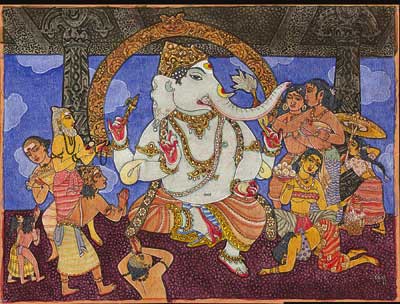
for the aspirant. Ganapati as a dancer points to dynamic,
harmonious activity geared towards progress.