| |
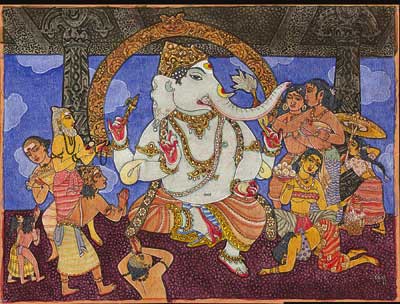
TRIAD OF THREE GREAT PILLARS HAVE HELD Hinduism
high, century after century: the satgurus, the temples and
the scriptures. Together they echo the greatness of the
loving God Ganesha, the Lord of Dharma, son of Siva. For
untold millennia our rishis and sages have proclaimed the
profound depths of the mind, assuring us that we, too, can
and must come to know God and the Gods. It is the living
presence of these satgurus and their spoken teachings
which has brought to life the traditional practices and
philosophy of the Sanatana Dharma. Now we shall delve into
the nature of Lord Ganesha, what He is like, what functions
this great God performs and find out how each seeker can
make Him a vital part of daily life's path of experience.
Once a psychic connection is made with Lord
Ganesha -- the Deity who manifests in several forms, including
the elephant-headed Lord of Categories and Remover of Obstacles
-- one is brought slowly into the mysteries of the Sanatana
Dharma. Such an inner connection, which can be as subtle
as a feeling, as tenuous as a dream or as bold as a personal
visit, is also an entering into one's own muladhara
chakra, governed by the planet Mercury, for every
opening into a new chakra is also an introduction to the
Deity who governs that state of consciousness and the planet
to which that chakra is connected.
The Sanatana Dharma, known today as Hinduism,
is the only living religion on the planet that does not look
to a human founder for its source of inspiration, scripture
or historical beginning. It is timeless and ageless. Sanatana
Dharma, the root religion of humankind, looks inward for its
origins, into the subtle, superconscious realms within the
microcosm, which it calls the Karanaloka, Sivaloka or Third
World. This great religion has no single organized headquarters
on the material plane. Nor does it have a one hierarchy. Who
then is in charge of Hinduism? Why, it is none other than
our loving Ganesha! He doesn't live in Rome, nor in Salt Lake
City. Lord Ganesha lives simultaneously everywhere Hindus
worship and pray within themselves. He doesn't have to be
reappointed from time to time, because yugas and yugas ago
He was permanently and irrevocably appointed when He was created
for this work.
Ganesha, the Great Gatekeeper
Yes, it
is the Great Ganesha who is the gateway for seekers into
the world's most ancient faith. He is the inner authority,
the guardian, the one who grants access to the spiritual
mysteries of the Sanatana Dharma. All Hindus worship Him,
regardless of their sectarian or philosophical positions.
He truly binds them together in His love. This great God
is both the beginning of the Hindu religion and the meeting
ground for all its devotees. And that is only proper, inasmuch
as Ganesha is the personification of the material universe.
The universe in all of its varied and various magnificent
manifestations is nothing but the body of this cheerfully
portly God.
Ganesha sits on the psychic lotus of the
muladhara chakra, the ganglia of nerves at
the base of the spine within everyone. This chakra governs
time, matter and memory. As the spiritual aspirant is lifted
up from fear and confusion into conscious awareness of right
thought, right speech and right action, the muladhara
chakra becomes activated. It is then that the seeker, with
heart filled with love, encounters the holy feet of Lord
Ganesha. As the spiritual seeker worships the loving elephant-faced
God, clearness of mind comes more and more as he automatically
and very slowly enters the Hindu path to enlightenment.
Once the connection is firmly established between the devotee
and Ganesha, all of the currents of the devotee's mind and
body become harmonized. After that strong connection is
made, should he falter on the spiritual path, he has gained
divine protection.
B ut the seeker loses one thing. He loses
his free, instinctive willfulness. It is lost forever. Yet
it is not a great loss. Man's own personal willfulness, his
animalistic free will, is a feeble and insignificant force
when compared to Lord Ganesha's divine will. When beholden
to God Ganesha and inwardly awakened enough to be attuned
to His will, it is then quite natural that the instinctive
will bows down. Personal likes and dislikes vanish. Limited
faculties of reason and analysis are overpowered and subdued
by a greater will, a cosmic will, the will of dharma.
When sufficient humility has been awakened, it is easy to
surrender personal, instinctive willfulness to the greater
subsuperconscious will of dharma. It happens most naturally,
but very slowly, because Lord Ganesha, of all the many Gods,
proceeds with methodic deliberation. He is the careful, loving
guide on the inner path of all seekers.
Among all the wonderful Hindu Deities, Lord
Ganesha is the closest to the material plane of consciousness,
most easily contacted and most able to assist us in our
day-to-day life and concerns. In His hands Ganesha wields
a noose and a goad. With the noose He can hold you close
or hold obstacles close. Ganesha can capture and confine
both blessings and obstacles. With the goad, Ganesha can
strike and repel obstacles. This Lord is called the Remover
of Obstacles; but He also places obstacles in our way, for
sometimes his devotees are proceeding in the wrong direction,
and His obstacles block their progress and guide them slowly
back onto the straight path of dharma. When instinctive
willfulness causes the seeker to decide to step out of the
boundaries of dharma, the Lord of Obstacles is there to
block the way. His emblem is the swastika, symbolizing
His circuitous course in guiding the seeker through life's
perplexing experiences.
Adopted by the Elephant God
Seekers of Truth come from many backgrounds,
many religions, and have trod many paths. Having become
acquainted with Lord Ganesha, they may wonder how their
past can participate in their present aspirations. "What
am I doing worshiping an elephant-faced God and loving it?"
they may wonder. "What do I do now to harmonize this unfoldment
with my previous upbringing?"
There is a way to reconcile this subconscious
dilemma. Let's not "pack it away in denial," as they say;
let's face up to the spiritual awakening. Truth is, you
have a loving friend in Ganesha, who, if we may use the
word, is the pope of the Hindu religion. And you are by
no means alone. One fourth of the human race is acquainted
with Ganesha -- twenty-five percent of the people on this
planet -- 1.25 billion, and that number is growing year
by year.
O ur loving Ganesha leads his devotees deep
into the oldest religion on planet Earth. There are two ways
to come into Hinduism. One is to be born into the Hindu religion
and be carried in your mother's arms to the temple, there
to be inwardly and psychically connected to our loving God,
Ganesha. So strong are those early impressions and samskaras
that they carry you through life. Another way is to unfold
naturally to the point of being ready to formally enter Hinduism,
to supplicate, to sincerely entreat the guardians of that
religion to allow you to be a part of that immense and ancient
tradition. You have to want to be a Hindu so strongly, so
sincerely, that Lord Ganesha lifts you out of the fog of the
materialistic conscious mind, establishing a connection and
a relationship with you. This is a personal relationship with
the Deity. There is nobody in-between -- just you and the
God, Lord Ganesha. It's like being adopted, in a way. If you
were an orphan or abandoned on the streets of Sao Paulo or
Madras or on the streets of wherever there are little kids
running around, you would be "free." You could go through
life listening to no one and exercising unrestricted free
will, free instinctive will. If you had a developed intellect,
then you could exercise an intellectual will. You could do
anything that you wanted to do, absolutely anything. Of course,
you would find that as you attempted to fulfill your desires,
you were limited, sometimes prevented, by the natural forces
within and without. But you could attempt anything.
If you were fortunate enough, foster parents might come along
to help you. They would adopt you and take you into their
home. Your new mother would begin to lovingly guide and direct
your life. She would tell you, "You can play as you like in
this room, but not in the others." She is a wise mother and
knows that you are accustomed to having your own way, so she
lets you play freely within the confines of your own room.
But if she catches you playing in another room, she might
say firmly, "You may play in your room, not here in this room."
You have lost your "free will" in being adopted by a mother
and father, you are a part of their family now, and your well-being,
your education, your training all now come under their will,
to which you must adjust yourself and obey. They will watch
over you and discipline you morning and night. They will protect
you from getting into trouble with your "free will." The modern
concept of freedom leads to the darker chakras below the muladhara
chakra. Anguish is there.
Developing a Personal Relationship
It is the same when you evolve a relationship,
a personal relationship, with the Deity Lord Ganesha. He
will not allow you to use your free will to get into difficulties.
Guiding you carefully and protecting you along your way
in your natural karma through life is His concern. Someone
once said, "I worship Lord Siva, I worship Lord Murugan,
but I have never really gotten acquainted with Lord Ganesha."
I responded, "You worship Siva and Lord Murugan, and that
is wonderful. But unless you have established a personal
relationship with Lord Ganesha, your worship of any of the
Gods is probably more according to your own thoughts and
fancy than true worship. Until you have established a rapport
with Lord Ganesha, you cannot establish a relationship with
Krishna, Ayyappan, Amman, Vishnu, Rama, Hanuman, Lakshmi,
Sita, Radharani, Siva or Murugan, outside of your own limited
concepts. It is Ganesha who introduces you to the millions
of Gods of the Hindu pantheon, no one else. That is the
way it works."
Yes, little by little, slowly, imperceptibly,
a relationship evolves, a very personal, loving relationship,
between the devotee and the elephant-faced God. Psychic
protection is granted, physical protection, mental and emotional
protection are all granted as boons by Him. He will not
allow His devotees to use their free, instinctive willfulness
to make more kukarma by getting into difficulties.
Rather, He will guide them carefully, protecting them every
moment along the way so that their natural birth karmas
may be worked through and sukarma created by right
living. This is His main concern. Lord Ganesha loves and
cares for His devotees. Once the devotee is connected to
Him through the awakening of the muladhara chakra,
loneliness is never experienced.
G anesha is a truly wonderful, loving God.
He has an extraordinary knack for unweaving complicated situations
and making them simple. He can unweave his devotees from their
karma, simplifying and purifying their lives. But this
only happens after they have established a personal relationship
with Him. Soon thereafter, changes begin to happen in their
lives; and when they go through difficult times, they no longer
become angry or live in fear or worry. When difficult times
come, they know it is because they are being unwound from
accumulated and congested, difficult karmas or being turned
in a new direction altogether. They know that at such a time
they have to consciously surrender their free, instinctive
willfulness and not fight the divine happenings, but allow
the God's divine will to guide their life. Such is the spiritual
path of total surrender, known as prapatti.
The
Meaning of Grace
"What about the grace of the Deity?" seekers
ask. Grace is received from the God when you are consistent
in your worship, consistent in your discipline, consistent
in your bhakti, your devotion. With such a foundation
in your life, a great shakti, a force or power, will
come from Lord Ganesha. This is grace. It is uplifting.
It comes unexpectedly. When grace comes, your mind may change
and your heart may melt. Your sight will become clear and
penetrating. You may say, "I have been graced to see everything
differently." New doors will begin to open for you, and
as you go through them, your life will become more full,
more wonderful. And the grace of it is that it would not
have ordinarily happened to you.
Seekers also inquire, "What is the difference
between grace and a boon from the Gods?" Grace is not exactly
a boon. A boon comes as the result of something that you
ask for and receive. A boon is quite specific. Grace comes
because of the state of the soul in conjunction with its
particular karma. It comes because we have done everything
right up to a certain point in time according to the laws
of dharma. It is then that the grace of the God comes.
Grace is not for a specific need or event in our life, as
a boon would be. Grace is more of a complete transformation
-- a metamorphosis. After receiving grace of a God, the
devotee can never be the same again, never look at life
again in the old way.
B y grace we are directed deeper into spiritual
life, pointed in the right direction, carefully guided on
the San Marga, the straight path to our supreme God. After
grace has been received, our thoughts are enlivened, our life
is inspired with enthusiasm and energy, and we live daily
in the joyous knowledge that everything is all right, everything
is happening around us in accord with our karma, our
dharma and God's gracious will.
The Gods Are Real Beings, Not Mere Symbols
Many people look at the Gods as mere symbols,
representations of forces or mind areas. Actually, the Gods
are beings, and down through the ages ordinary men and women,
great saints and sages, prophets and mystics in all cultures
have inwardly seen, heard and been profoundly influenced
by these superconscious, inner-plane, inner-galactic beings.
Lord Ganesha is just such a being. He can think just as
we can think. He can see and understand and make decisions
-- decisions so vast in their implications and complexity
that we could never comprehend them with our human faculties
of limited understanding.
In recent history, missionaries and others
from the Western religions have told the Indian people over
and over again that their Gods are not real beings, but
merely symbols of spiritual matters -- and unfortunately
many have begun to believe this and look at their Gods in
this way. Even among Hindus there are quite a few who don't
believe in inner-world beings. Their belief is restricted
to the people they see in the physical world, and that is
all. You dare not tell them differently. It is very difficult,
but not impossible, to introduce them to the grand philosophy
which is based solely on worship, meditation, inner discipline
and the search for Absolute Truth. But this is too high-minded
for those living in the everyday materialistic consciousness.
For the knowledge of inner worlds to become accepted, a
personal realization has to occur. This is a slow process
for the materialist, a very slow process, and only Lord
Ganesha can help it along. To contact Lord Ganesha, it is
imperative that the materialist visit one of His temples
or shrines, to make initial contact. It only takes one meeting.
How to Approach the Deity
When you approach the Deity, you should
believe that Ganesha feels your presence, that He sees you
just as you see Him. In thus seeing Him in very human terms,
you will get to know Him better. You will develop a very
human relationship with Him. It is especially important
that you develop this relationship with Lord Ganesha. It
will not be difficult to nurture a friendly feeling for
Him, because Ganesha is the Deity who governs our instinctive-intellectual
state of mind. He governs the instinctive mind of all the
animals, the insects, the birds and the fish, and governs,
as well, all the forces of prakriti, nature. Lord
Ganesha is also the Deity who governs the higher intellectual
mind, of science and profound knowledge. This is why they
call Him Lord of Categories. As Lord of Categories, He organizes
and clears the intellectual mind so that individual awareness
can flow unhindered in the many areas of developing thought.
As Lord of Obstacles, He creates and removes obstacles so
that karma becomes more and more perfect as the refinement
process of living through the experiences of life continues.
In the temples of India, even the offerings
that come in through the day from pilgrims, who bring silver,
gold and gifts of all kinds to be placed into the hundi,
are counted at nightfall before the Deity. He sees this
and is told of all that was given to Him, and He knows.
At night, the Deity is ceremoniously put to bed. They treat
Him in very human terms. In the morning He is symbolically
awakened, then bathed and dressed. The Deity is treated
just as if He were a human person. Well, in the Third World
that kind of dedication, intense bhakti, is noticed,
and it is appreciated.
Connecting the Three Worlds: Hindu Magic
Now you might wonder, "Where are the inner
worlds?" It is where you were just before you were conceived.
They are in the nonphysical microcosm of this macrocosm.
When you were conceived, you began to slowly grow a new
physical body inside your mother. At that time you were
living in your astral body in the nonphysical microcosm.
You existed, to be sure, but not in this physical macrocosm.
The devas and Deities are all in that nonphysical
microcosm. They actually exist inside material existence,
for there are many worlds, or planes of existence, within
the physical world. If you were to go into the physical
microcosm, into a cell and into an atom, and into the inside
of that and the inside of that, you would come out in the
macrocosm of the Gods. This is called the Sivaloka or Third
World. Their macrocosm is bigger than our macrocosm.
T he concept of this inner space is different
than we ordinarily conceive. Even though their macrocosm exists
within this macrocosm, it is larger than this macrocosm. Of
course, that immensity is in another dimension, another world.
And each world is larger than the one before -- the world
of departed souls is larger than this physical world, and
the world of the Gods is much larger than the heaven worlds.
Therefore, in a tiny space in this physical world hundreds
of thousands of devas exist -- in a very tiny space.
Establishing the Link Through Puja
When the temple priest invokes the inner
worlds and the beings within them, he is consciously trying
to establish a channel of communication. When he is successful,
this physical microcosm opens into the devonic macrocosm.
In other words, through conscious effort, he connects the
inner and outer worlds, even to the point that devotees
may see the transfiguration of the God, or Mahadeva, superimposed
over the stone image of the Deity in the temple. They can
actually see the God, as He is in the inner world. Many,
many awakened souls have seen such things -- the eyes of
the God moving, for instance -- and some gurus can actually
hear the God speak to them. The God is still in the inner
world when this happens. It is the temple that has tuned
into His world. This is much like live TV. Hundreds of sets
can be tuned into the same station at the same time and
view actual happenings as they occur.
The God, therefore, does not travel from
the altar of one temple to the altar of another temple.
The procedure is similar to that of dialing a friend on
the telephone and bringing his voice across a vast distance
into your ear. The friend can be heard quite clearly, but
he has not moved to another place. The telephone could be
likened to a connection between the gross and the subtle
worlds, the world of matter and the worlds of spirit, or
akasha.
Where Do We Go When We "Die?"
Where does the soul go when a person dies?
It goes into the subtle microcosm and then into a larger
macrocosm, or greater world, and ceases for a time to function
in this gross macrocosm because it is not living in a physical
body. At death, the soul drops off the physical body and
travels in and in and in to subtle worlds, inner worlds
of existence that have their own expansive space, their
own macrocosm.
S mall children, four or five years old, who
can speak but have not yet become too immersed in the learned
reality of the conscious or external mind, often tell their
parents that they remember when they were born and even before.
I have had children tell me, "I came from a world that was
bigger than this world." And they talked about the activities
that go on there and described the people living there. Of
course, as they grow older and become involved in the external
thought processes, these memories fade away. This is the kind
of experiential knowledge that makes religion come alive in
us, more real and useful. True religion should be the most
real and solid and certain thing in our entire life. When
we ponder these inner worlds, we learn from within ourselves
how they relate and interrelate with each other.
Ponder the many visions that prophets have spoken of experiencing,
of all the angels or devas that have graced mankind with their
presence and their prophecies. Ponder the mystic human events
that cannot adequately be explained by the rational intellect.
Think of them all in terms of the inner worlds of existence,
and all will become clear. Yes, one day it will all become
clear, from the inside of you to the external intellect. This
is real knowing. This is the building of faith. This is true
Hinduism, the bedrock of daily life. When this knowing comes
from the depths of your knowing state of consciousness, the
temple will be the home of the Gods to you.
Worship
and Meditation on Lord Ganesha
Worship, bhakti yoga, is a definite discipline
and practice to be perfected according to the aptitude of
the devotee. After bathing and preparing the mind, approach
Lord Ganesha in the shrine or temple, bringing a small gift
or flower to be placed at His holy feet. Consider that you
are approaching and about to meet the most important person
in the world. Make your offering and prostrate. As you prostrate,
feel the energies of love and devotion flow along your spine
and out through the top of the head and into the home shrine
altar or sanctum sanctorum, garbhagriha, of the temple,
and offer those pure actinic energies to Lord Ganesha. Rise
and walk slowly three times around the sanctum, always clockwise.
M editation, dhyana yoga, is a discipline
you can perform after worshiping that will, when diligently
and consistently practiced, brings its own rewards. Sit before
the Deity and bring up the images of your own father and mother,
then the family guru and finally the darshana of the
elephant Lord. Now meditate upon His form, His eyes, His ears,
His trunk, His two tusks, His belly, in which rests the whole
world. The first time your mind wanders into the thought patterns
of daily life, bring it back to your parents, your guru and
the first Lord to be worshiped before proceeding on to any
other of the 330 million Gods of our ancient Sanatana Dharma.
The objective is to maintain an unbroken
continuity of thought and to not allow the mind to wander
away from the darshana of the God. You can begin
this meditation by pondering the obvious physical properties
of the worshipful image. If it is made of stone, think of
the stone. How large is it? Where was it quarried and how
was it carved? What are the various parts of the Deity and
what do they mean? What are his symbols and what do they
mean? Recall them to memory. If it is a picture of Ganesha,
ponder how that picture was produced. Continue to explore
the Lord Ganesha with your mind. Later you can move on to
less physical points of concentration. You will find that
your awareness or mind will wander to unrelated areas, to
concerns of the past or worries of the future. When it does,
bring awareness back to your point of concentration -- the
Deity, Lord Ganesha. Begin again your stream of thoughts
toward Him, and when the mind once again wanders, use your
willpower to bring it back to His darshana.
This may be difficult at first, but constant
practice will unfold new knowledge from within you, knowledge
that you never knew existed and did not learn from the outside.
When that happens, concentration is strong and meditation
is not far away. You should be able to have twenty, thirty
or even fifty thoughts on loving Ganesha in sequence without
awareness being distracted into areas of the external mind.
It will help if you learn to breathe diaphragmatically during
these exercises. Breathe deeply but naturally, without strain
or effort. As we control the pranas of the breath,
we simultaneously control awareness so that it remains steady
and does not move here and there. You also have to teach the
body to sit still, to remain poised and not restless. All
of this will come in time, not immediately. Be patient. Never
become upset with yourself when distractions arise, for that
is a greater distraction still. Simply accept each departure
from your concentration as an opportunity to become stronger
and more one-pointed, and then quietly and firmly bring awareness
back to its subject, Lord Ganesha.
You must teach this simple meditation to
your children, and together the entire family will learn
much about the Gods of our religion. It will inspire one
and all to read more about Them, to study Their stories
and memorize Their sacred chants. The Gods will come to
life within your own mind and every member of the family
as you penetrate behind the symbols and the stories and
discover the true nature of Divinities. It is not necessary
to practice this meditation for extended periods. A few
minutes each day is enough. Once your brief meditation is
finished, sit quietly in His darshana and enjoy His
energies merging with your own pranic radiations.
Take that darshana and that love out of the temple
when you leave, spreading it among all the peoples of the
world that they, too, may come to know and love the endearing
God of Hinduism.
|
|